BNPL Was Built to Bypass Banks. Europe Is Turning It Into One.
Europe harmonizes, the US fragments: what BNPL’s regulatory split means for consumers, providers and banks.
Europe harmonizes, the US fragments: what BNPL’s regulatory split means for consumers, providers and banks.
On 20 November the EU pulls buy now, pay later into consumer-credit law. The UK did the same in July. In the US, the federal regulator went the other way. I went through the filings, the UK regulator’s own projections and the survey data to answer one question: who actually pays for this, and who comes out ahead?
My answer: the consumer pays first, and the winners are the players that already look like banks. BNPL was built to bypass banks. In Europe, it now has to become one to survive.
Europe’s old consumer-credit rules (2008) did not cover loans under €200, interest-free credit, or credit repaid within three months. Pay-in-4 sits almost exactly inside that gap: six weeks, zero interest, a small basket (wiki.private.law). The UK had a similar exemption.
That is why a shopper could be approved in seconds with a soft check. Part of it was good product design. Part of it was that nobody required more. Most coverage treats BNPL’s speed as pure innovation; I think a share of it was regulatory arbitrage, and that share is now going away.
Four markets, two directions:
| Company | What changed | When |
|---|---|---|
| EU | BNPL becomes regulated credit: creditworthiness checks, disclosure, national fee caps | 20 Nov 2026 |
| UK | A creditworthiness check before every BNPL agreement, even under £50 | 15 Jul 2026 |
| Australia | Credit licence required; income and expenses verified | Jun 2025 |
| US | Federal rule withdrawn; New York passes its own BNPL law | 2025 |
Europe is moving to one rulebook. The US has no federal rule but a growing patchwork of state laws, so “unregulated” there is less permanent than it looks.
The UK regulator projects that lenders will lose about £1.4bn under the new rules. £929m of it, 68%, comes from fewer transactions. Compliance costs are only 15%. Merchants are projected to lose roughly another £1.4bn (City AM, FCA projection reported Feb 2026).
So the real cost of the rules is not paperwork. It is shoppers who can no longer use the product. That matters because of how BNPL makes money: merchants pay the fee (typically 2–8%) only because shoppers choose BNPL. The chain runs consumer → volume → merchant fees, and the consumer is the first domino.
The US data points the same way, even without regulation. Card installment plans are already used by 2.4x as many Americans as BNPL (33% vs 14%), and in one year card installments grew 43% while BNPL slipped 7% (PYMNTS). Banks are copying BNPL’s convenience inside the card. In Europe, the rules now take away BNPL’s other edge: speed.
The players that come out ahead share two things: a balance sheet and borrower data. The ones most exposed competed on speed and instant approval.
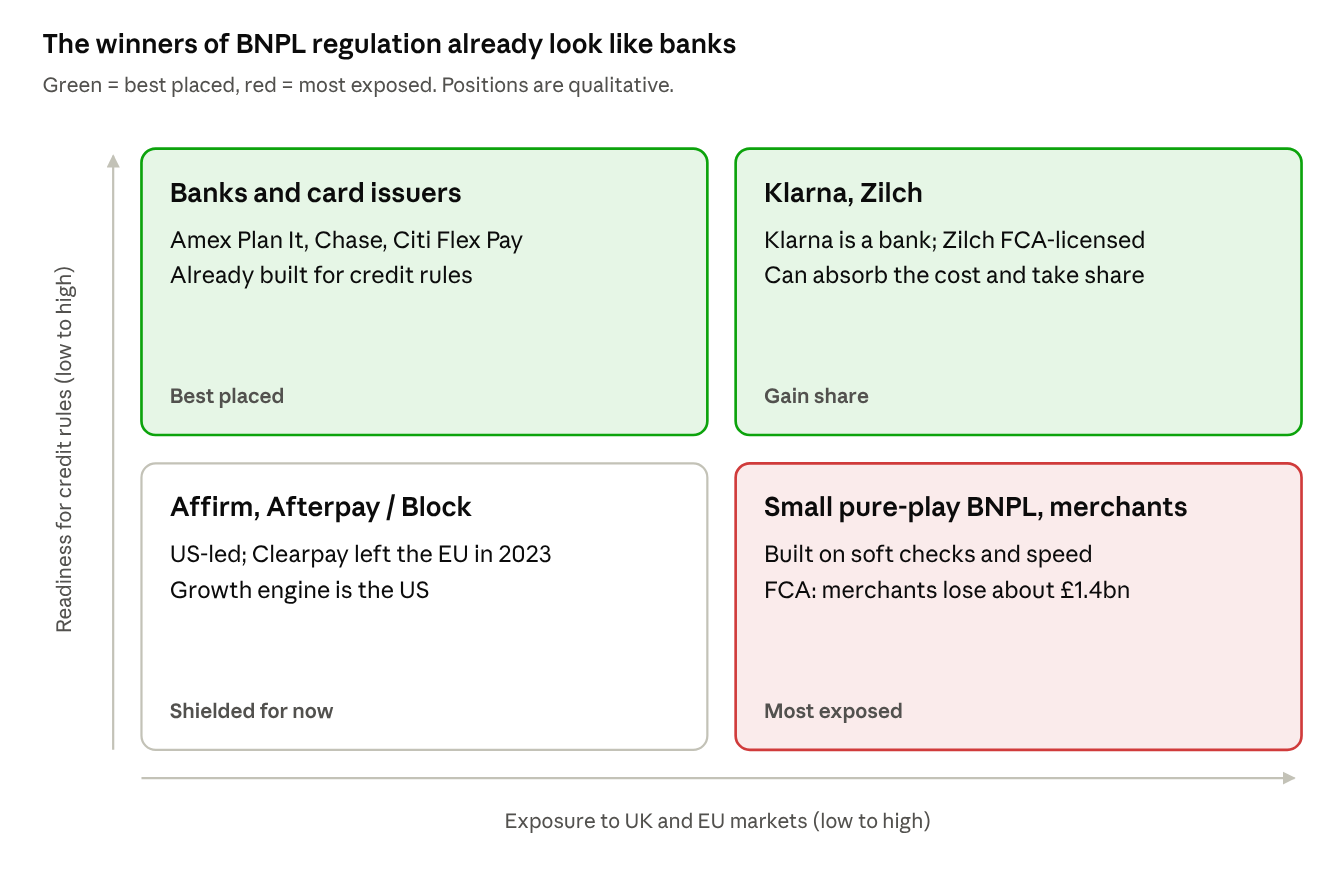
The BNPL firms that look safe have already moved toward banking. Klarna holds a Swedish banking licence and takes deposits. Zilch was the first BNPL firm with a full FCA licence, funds itself through bank-arranged facilities and now runs installments on a Visa card (Visa). Oliver Wyman’s read of the EU rules lands in the same place: banks are best positioned, fintech BNPL faces the most pressure (Oliver Wyman). Clearpay leaving France, Italy and Spain back in 2023 shows how thin the European margins already were (City AM).
Firms survive by becoming a bank (Klarna) or plugging into one (Zilch). Independent, frictionless BNPL is the model that shrinks.
What would change my mind: Klarna’s reach (120m consumers, 1.2m merchants) holding its European share through 2027.
Klarna’s US volume grew 9 points faster than the group in Q2 2026 (Klarna), and Affirm’s growth engine is American.
What would change my mind: more states copying New York, or a federal rule coming back.
Letting consumers move freely is only half of it; the product also has to be economically sustainable. Europe is now testing whether BNPL can be both, and only players with balance sheets and data can afford that test.
The other side: the regulator’s view is that some of the shoppers who get declined should not have been borrowing in the first place.
Every figure here comes from public filings, regulator projections or industry surveys and is traced in the evidence workbook.