Fintech / Business Analysis

BNPL Regulation — Europe Harmonizes, the US Fragments

An analysis of buy now, pay later’s regulatory split — the EU and UK pulling it into consumer-credit law while US regulation fragments — and what it means for consumers, providers and banks.

Who pays, and who comes out ahead?

The EU brings BNPL into consumer-credit law on 20 November 2026; the UK did the same in July. I went through the filings, the UK regulator’s own projections and the survey data to answer one question: who actually pays for this, and who comes out ahead?

My answer: the consumer pays first, and the winners are the players that already look like banks.

The speed was partly a loophole

Europe’s 2008 consumer-credit rules did not cover loans under €200, interest-free credit, or credit repaid within three months. Pay-in-4 — six weeks, zero interest, a small basket — sits almost exactly inside that gap, and the UK had a similar exemption.

Part of BNPL’s instant, soft-check approval was good product design; part of it was regulatory arbitrage, and that share is now going away.

Europe harmonizes, the US fragments

Four markets, two directions.
CompanyWhat changedWhen
EUBNPL becomes regulated credit: creditworthiness checks, disclosure, national fee caps20 Nov 2026
UKA creditworthiness check before every BNPL agreement, even under £5015 Jul 2026
AustraliaCredit licence required; income and expenses verifiedJun 2025
USFederal rule withdrawn; New York passes its own BNPL law2025

Europe is moving to one rulebook. The US has no federal rule but a growing patchwork of state laws, so “unregulated” there is less permanent than it looks.

The number that matters: 68%

The UK regulator projects lenders will lose about £1.4bn under the new rules, and merchants roughly another £1.4bn. Most of the lender loss comes from fewer transactions, not compliance.

Projected lender losses under the UK rules (FCA projection, reported Feb 2026).
CompanyProjected impact
Total lender lossesabout £1.4bn
From fewer transactions£929m (68%)
From compliance costs15%

Merchants pay the fee (typically 2–8%) only because shoppers choose BNPL. The chain runs consumer → volume → merchant fees, and the consumer is the first domino.

The US points the same way without regulation: card installment plans are used by 33% of Americans versus 14% for BNPL, and in one year card installments grew 43% while BNPL slipped 7%.
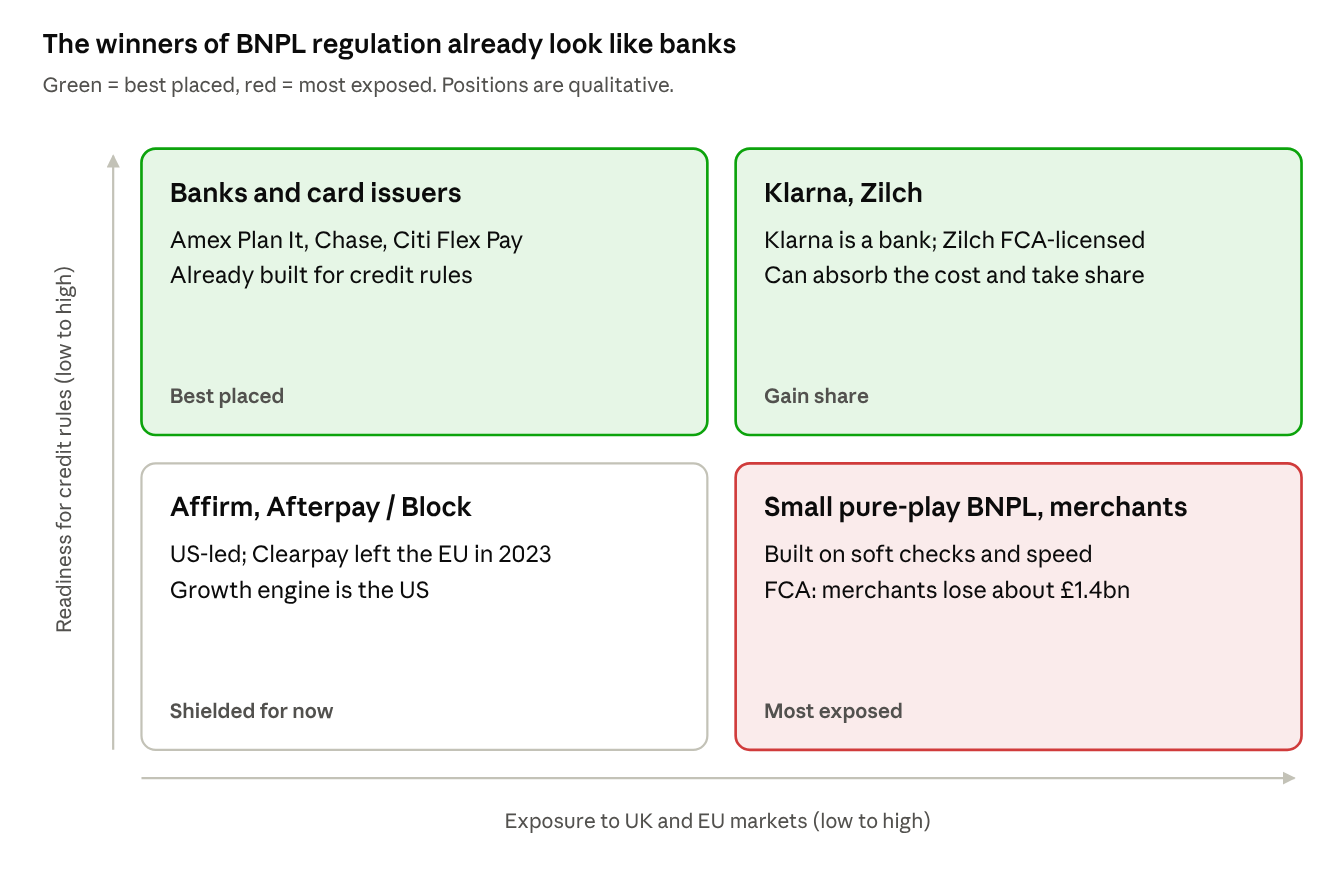
The winners already look like banks

The players that come out ahead share two things: a balance sheet and borrower data. The ones most exposed competed on speed and instant approval.

Two-by-two chart. Vertical axis: readiness for credit rules, low to high. Horizontal axis: exposure to UK and EU markets, low to high. High readiness, low exposure — banks and card issuers (Amex Plan It, Chase, Citi Flex Pay), already built for credit rules: best placed. High readiness, high exposure — Klarna and Zilch (Klarna is a bank; Zilch FCA-licensed), can absorb the cost and take share: gain share. Low readiness, low exposure — Affirm and Afterpay / Block, US-led, Clearpay left the EU in 2023, growth engine is the US: shielded for now. Low readiness, high exposure — small pure-play BNPL and merchants, built on soft checks and speed; FCA: merchants lose about £1.4bn: most exposed.
Green = best placed, red = most exposed. Positions are qualitative.

Klarna holds a Swedish banking licence and takes deposits; Zilch was the first BNPL firm with a full FCA licence and now runs installments on a Visa card. Clearpay’s 2023 exit from France, Italy and Spain shows how thin European margins already were.

My calls

  1. In Europe, BNPL becomes a bank feature, not a standalone product. Firms survive by becoming a bank (Klarna) or plugging into one (Zilch).
  2. Growth shifts to the US, but only for now. Klarna’s US volume grew 9 points faster than the group in Q2 2026, and Affirm’s growth engine is American.
  3. Innovation in finance has to pay its own way. Only players with balance sheets and data can afford Europe’s test of whether BNPL can be both open and economically sustainable.

Method

Every figure comes from public filings, regulator projections or industry surveys and is traced in the evidence workbook.