Co-Founder

Narsent

Narsent started from a simple question: could receivables data be turned into better day-to-day collection and cash decisions, rather than just another reporting dashboard?

The product focused on helping companies understand which receivables were becoming risky, what that meant for future cash flow, and where teams should act first.

From reporting to decisions

Receivables teams often have plenty of transactional data but still rely on manual follow-up, static aging reports, and individual judgment to decide what deserves attention.

The problem was not only predicting whether a payment might be late. The harder part was turning that signal into something operational: which account should be prioritized, what risk was changing, how cash flow might be affected, and what action should follow.

A decision layer for receivables

We explored Narsent as a decision-intelligence layer for collection and cash operations.

The product combined:

  • receivables and payment-risk analysis
  • collection prioritization
  • DSO and cash-flow visibility
  • risk signals around non-payment and delay
  • suggested actions for relevant teams
  • AI-assisted interpretation of the underlying data

Selected platform screens

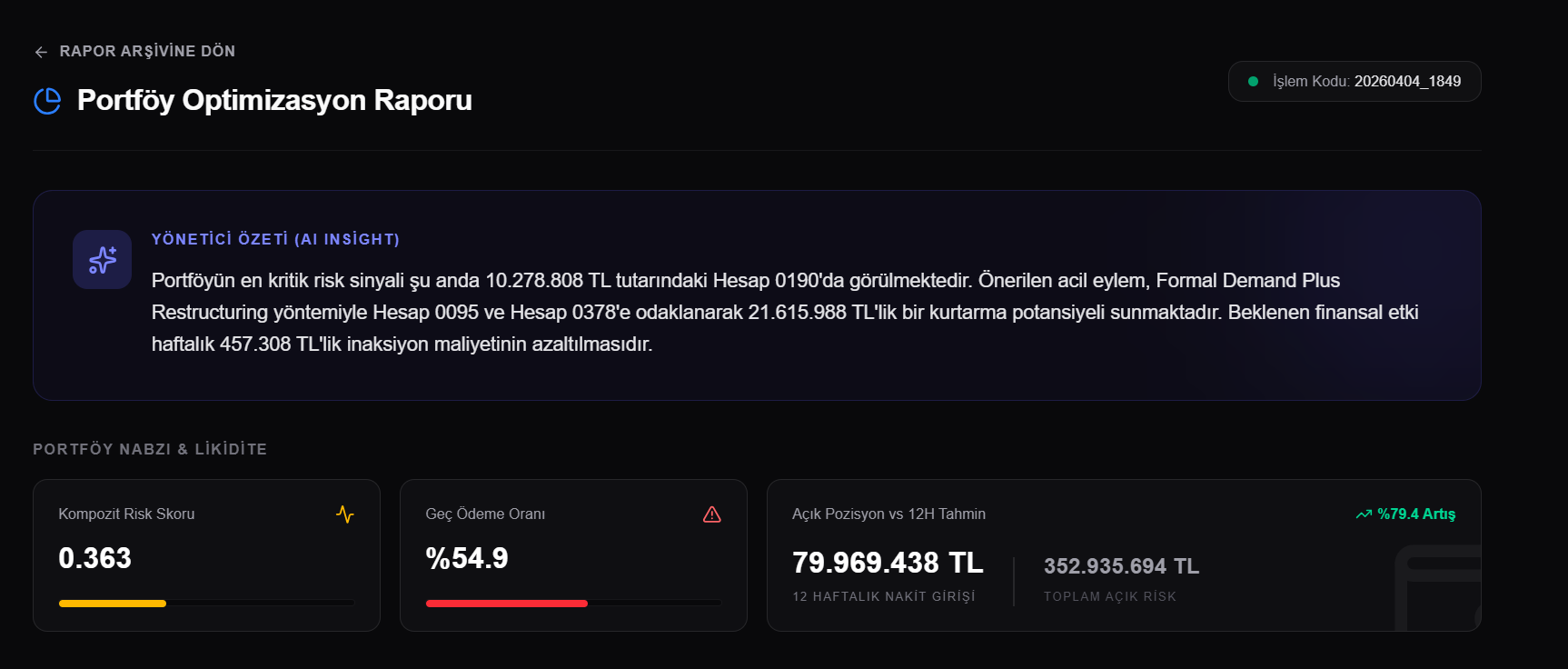
Portfolio optimization report showing an AI-generated executive summary and portfolio risk metrics in Turkish
AI-generated executive summary and portfolio-level risk overview.
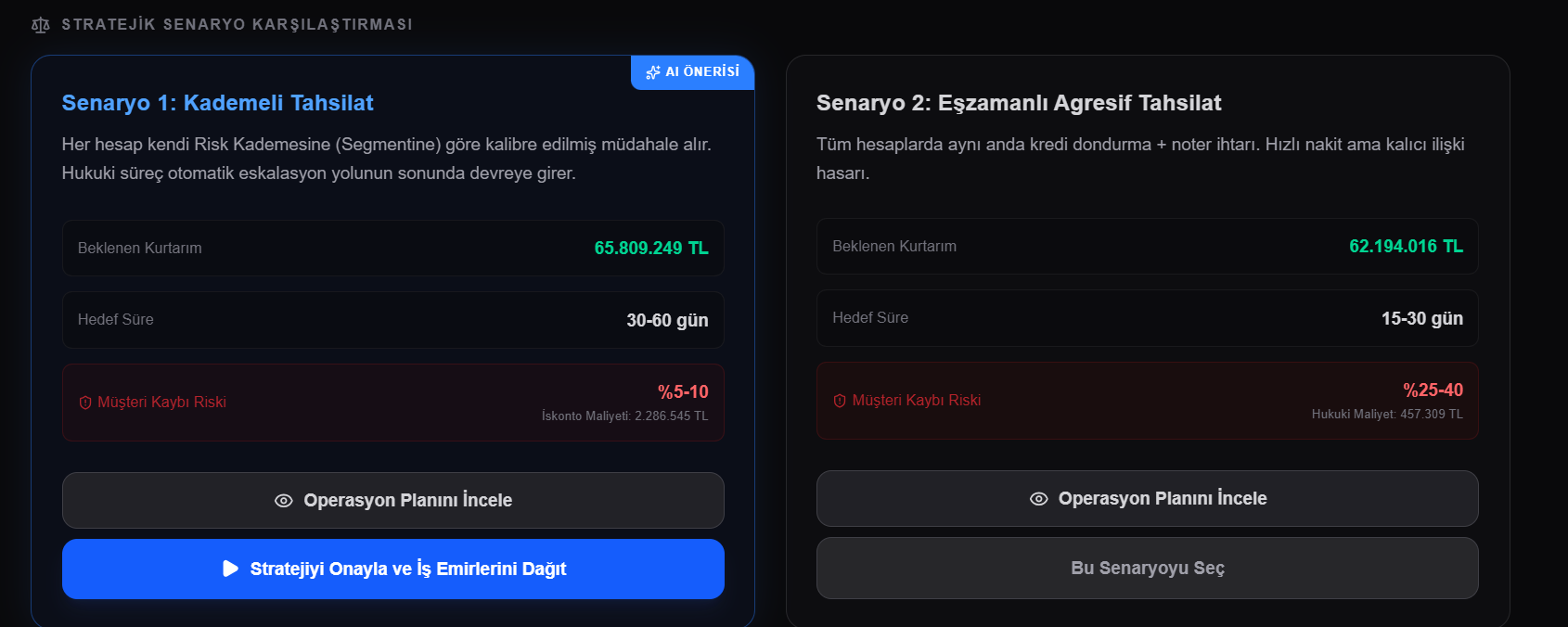
Strategic scenario comparison showing two recovery strategies with expected recovery amounts, durations, and customer-loss risk in Turkish
Alternative recovery strategies compared by expected recovery, duration, and customer-loss risk.
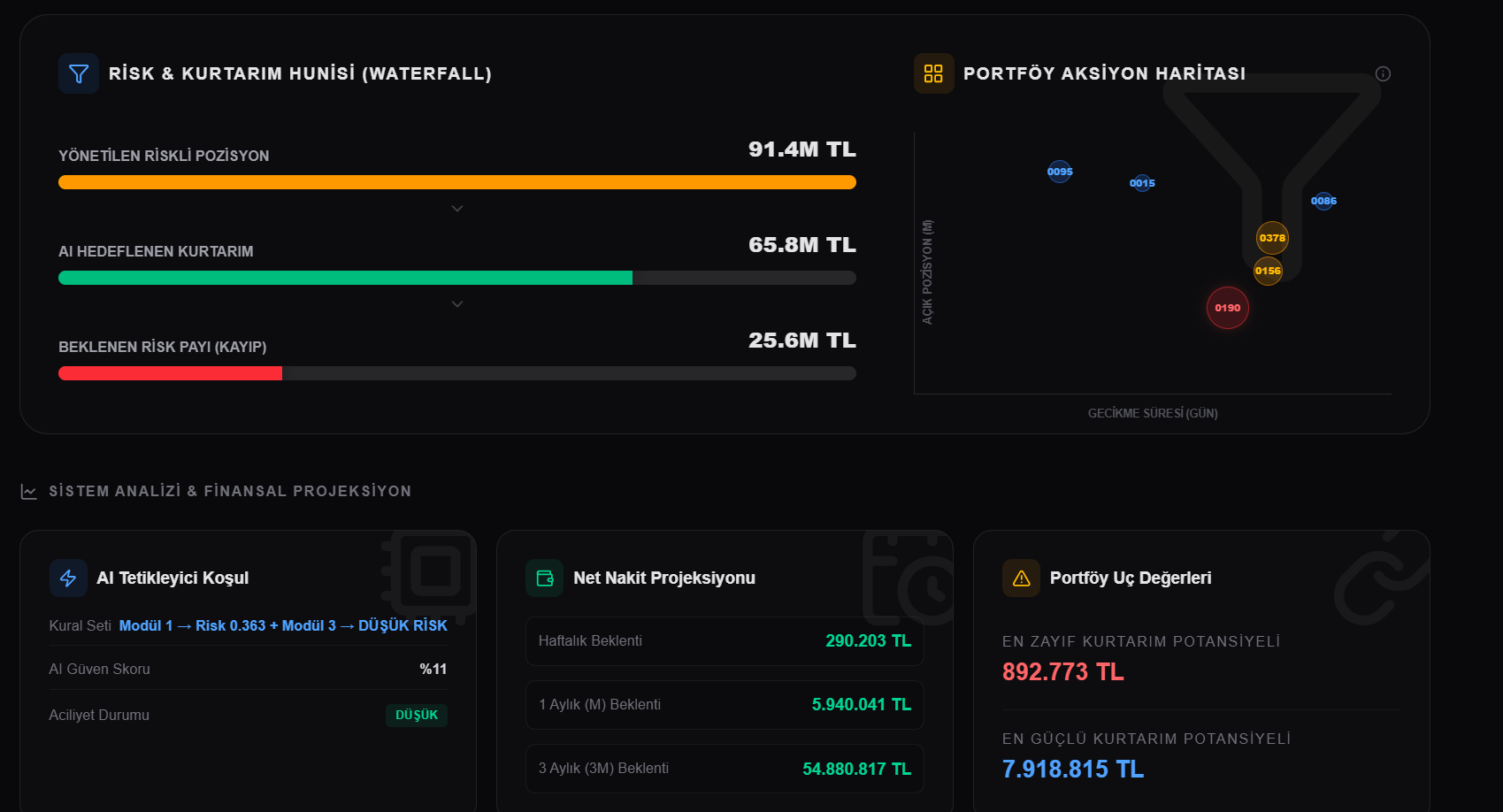
Risk and recovery waterfall with a portfolio action map and projected financial figures in Turkish
Waterfall logic, action mapping, and projected financial impact across the portfolio.
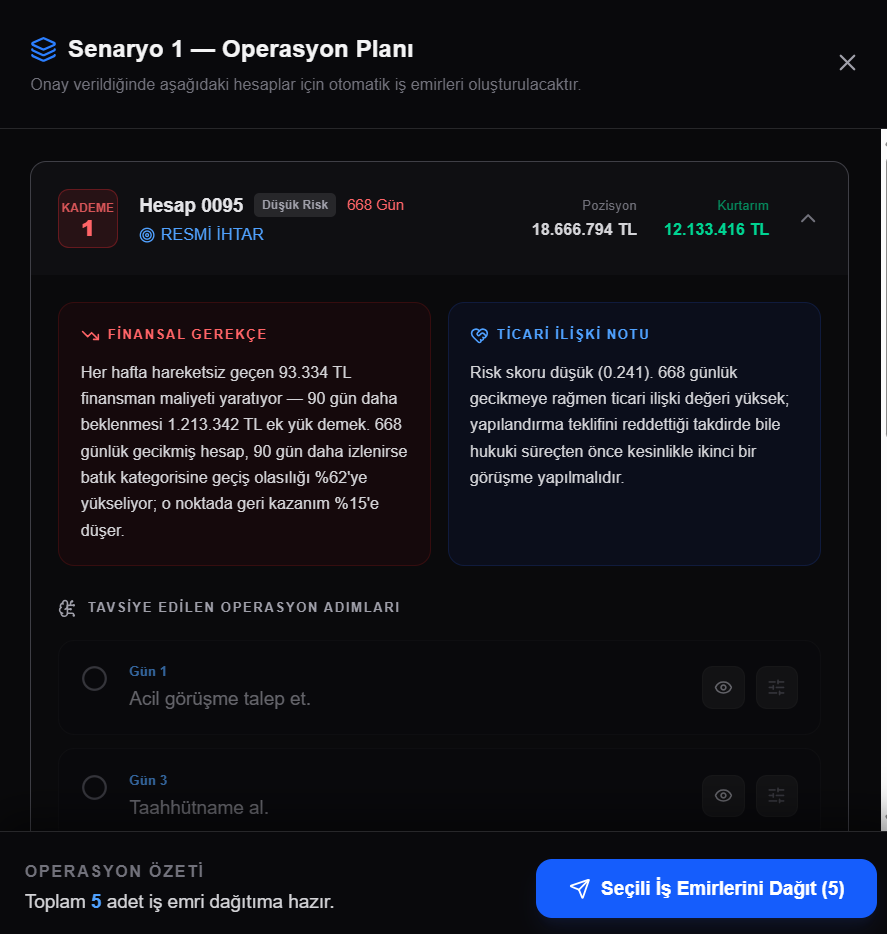
Account operation plan showing financial rationale, relationship notes, and recommended steps in Turkish
Account-level rationale, relationship notes, and recommended next actions.

Working across product, data, and strategy

As a co-founder, I worked across the parts of the project that sat between the business problem and the technical system.

My work included:

  • shaping the product and decision logic
  • product strategy and business analysis
  • designing the AI Decision Engine
  • defining product and operating KPIs
  • technical architecture and early prototypes
  • customer discovery and commercial validation
  • customer and enterprise conversations
  • stakeholder engagement across the ecosystem
  • market and ICP work
  • translating user problems into product requirements
  • coordinating product development across product and technical work
  • representing the venture in conversations with corporate stakeholders, ecosystem participants, and potential investors

The decision engine

The core idea was to move beyond a single risk score.

Signals from customer behavior, receivables, payment history, and forecasting could be combined into a decision layer that answered three questions: 1. What is changing? 2. Why does it matter? 3. What should happen next?

The system was designed to connect analytical outputs with operational actions rather than leave predictions isolated in a model or dashboard.

Predictive risk models were one input into the broader decision system; the detailed modeling work will have its own separate Work entry.

The words “Achieve your goals with NARS Engine” in glowing purple script on a black background
Early NARS Engine visual

Validation and the startup ecosystem

A large part of Narsent happened outside the product itself. We spent time speaking with companies, testing use cases, understanding how finance and operations teams actually worked, and figuring out where the product could create enough value to justify adoption.

Customer discovery and process discussions included organizations such as İZSU, Enerjisa, TurkNet, Gdz Elektrik, Arz Portföy, and Eksim Ventures.

At the same time, Narsent entered several startup and accelerator programs. That brought the project into contact with mentors, founders, corporate stakeholders, ecosystem operators, and potential investors, and gave us a much more practical view of how an early-stage company develops beyond the product.
Selected milestones

TEKNOFEST 2025
Financial Technologies finalist
GVG 2026
Fintech finalist
İTÜ Çekirdek
Selected startup
VK Boost
Selected startup / acceleration program
Enerjim Sensin
TOP 20
TİM-TEB Girişim Evi
Selected entrepreneur / startup program
Teknopark İzmir Classboom
Selected startup

What I learned

Narsent gave me a close look at the distance between an interesting technical idea and a product a company might actually adopt.

It forced me to think about modeling, product design, customer workflows, commercial value, and implementation as parts of the same problem.

The project eventually ended, but it became one of the experiences that shaped how I approach business and technical problems today.